
by Lauren Regan, founder and Director of Litigation & Advocacy at CLDC
For almost 25 years the Civil Liberties Defense Center has been a small, finely honed powerhouse of movement lawyers defending the very frontline of environmental and social justice activists. Though small in size, we focus our work on providing full continuity of legal support to groups and individuals.
Long before actions are taken, we often provide legal consultations, research, and know your rights and risks trainings. If necessary, we also provide pro bono (no cost) criminal defense in state and federal courts (or help find lawyers and legal teams), we sue cops and governments for violating the rights of activists with the intent of helping to prevent future abuses from happening to other activists and communities, and we take on SLAPP and lawfare cases in weird little corners of the law that most lawyers don’t—like fighting grand juries, subpoenas and other corporate/government attacks on the right to organize, speak and vociferously dissent against the systems that result in the suffering of living things.
When we are figuring out what cases we can take, we use a matrix of factors like: will this case be precedential—is there a chance it could result in gains or losses for left movements? Where is the case located and are there movement lawyers ready and able to take the case adequately (and sometimes we then just offer to support from afar instead)? How serious are the potential harms, and will our 30 years of litigation experience make a difference to the targeted human and their case?
And of course, is the case and client in line with our values, including not cooperating with the State against other political movement participants.
It is for all of these reasons that we are currently defending amazing activists in both current federal cases in Minnesota, the Righteous 39 and the MN 15. When people from other countries ask me what does state repression look like in the US right now, I tell them about these two federal criminal cases taking place right now in the US District Court in Minneapolis, Minnesota.

The first case, US v. Armstrong-Levy, was indicted on January 29, 2026. You might remember the headlines about this case because Trump altered the mugshot photo of a black female civil rights lawyer, Nekeema Armstrong-Levy, to make it appear she was crying. A second round of arrests occurred on February 27, 2026, which included our client Amelia Hansa, a racial justice activist and librarian.
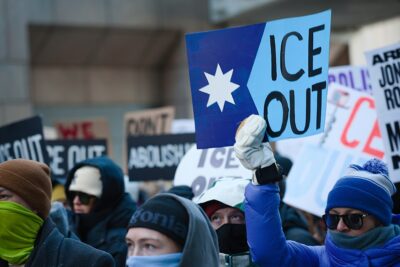
All 39 defendants (“the Righteous 39”) are accused of holding a nonviolent protest against an ICE official who also serves as a religious pastor. The protest allegedly occurred during a religious service as community members outed the ICE goon-pastor for immoral and despicable acts against fellow community members. Humans participating in human rights crimes against immigrants and their communities do not get to hide their conduct from their neighbors and/or parishioners. History has taught us severe lessons about shrouding those who commit atrocities in the name of the State from public transparency and accountability.
The two most important legal takeaways so far in this case are (1) the Department of Justice is bowing to the religious right by attempting a massive expansion of the criminal FACE Act to attack and silence any protest that occurs in or near a religious building; and (2) Department of Homeland Security (DHS), ICE, and Homeland Security Investigations (HSI) are violating the law and the constitution by a newly hatched plan of using an import/export trade administrative summons to search and seize potential evidence in a major federal criminal case—circumventing search warrant requirements and violating 4th amendment and Due Process rights.
Meritless Expansion of the Scope of the FACE Act
The Department of Homeland Security through Homeland Security Investigations (housed within DHS) initiated and directed the investigation of nonviolent anti-racist and anti-ICE protestors for alleged violations of domestic civil rights offenses under 18 USC 24, conspiracy against rights, and 248(a)(2), freedom of access to clinic entrances.
The Freedom of Access to Clinic Entrances Act is a law that was passed in the 90s when violent religious extremists were murdering abortion providers and firebombing clinics. In order to get the law passed in Congress, a lesser second section was added as a gift to the religious right.
This section of FACE had never been used to criminally prosecute anyone until the Righteous 39 case.
(a) Prohibited Activities.—Whoever—
(2) by force or threat of force or by physical obstruction, intentionally injures, intimidates or interferes with or attempts to injure, intimidate or interfere with any person lawfully exercising or seeking to exercise the First Amendment right of religious freedom at a place of religious worship”
18 USC 248(a)(2).
Simply put, an anti-racist/anti-ICE act of nonviolent civil disobedience that is focused on the ICE commander and takes place at Cities Church in St. Paul, Minnesota, where the ICE commander happens to preach, in no way falls within the scope of this criminal statute. This prosecution is clearly a politically motivated abuse of power that serves the far-right religious facets of the authoritarian Trump regime.
Our client and the other members of the Righteous 39 are political targets of this regime’s tactic of prosecution as punishment—we will get these charges dismissed because they have no legal merit whatsoever—but these activists have been forced to deal with this stressful prosecution for over 8 months thus far.
Illegal Use Of §1509 Administrative Summons in Criminal Investigations
In order to make lemonade out of the regime’s lemons, our defense teams have used this prosecution of nonviolent protestors to expose the government’s illegal surveillance tactics. One of the major ways this has occurred thus far is in our attack of HSI’s outrageous abuse of 19 USC §1509 summons (the customs administrative summons or 1509 summons).
Normally in criminal investigations, the FBI or other law enforcement agency will apply for a search warrant from a judge before searching and seizing evidence of a crime.
In this case, HSI went to a judge twice to get a search warrant and was flatly denied!
A judge denying a request for a search warrant is super rare because judges give cops tons of leeway in obtaining search warrants. Once HSI was denied a lawful search warrant they went back to their caves and with the help of evil-doers came up with this bullshit illegal strategy of dusting off this statute that allows customs agents to request import and export customs records and proclaiming for themselves that HSI could use these administrative customs summons to do what they were prohibited from doing by the judge.
So far in this case, we have determined that HSI invoked a customs administrative summons 92 times to investigate and prosecute the Righteous 39.
This is totally illegal for two main reasons.
First, DHS does not possess jurisdiction (or legal authority) to investigate every federal crime; they have a very narrow lane that Congress expressly assigned to them.
The statutes (or legal authority) the Government invokes concerning immigration, customs enforcement, and the powers of customs officers do not provide them with legal authority to undertake a domestic criminal investigation against US citizens not engaged in border trade.
Second, even if HSI possessed authority to participate in the investigation of the Righteous 39, that does not give them the authority to exercise subpoena power under 19 U.S.C. § 1509 in place of a valid search warrant signed by a judge.
As argued in Defendants’ Motion to Dismiss,
Congress did not give HSI general administrative subpoena power through this statute. Instead, Section 1509 limits the HSI’s subpoena power to investigations and inquiries conducted for specified purposes, including “insuring compliance with the laws of the United States administered by the United States Customs Service.” 19 U.S.C. § 1509(a). Although Congress transferred customs functions to DHS, it did not erase the statutory limits Congress placed upon its exercise of those functions.
The scale and duration of HSI’s use of subpoena power matter. Investigators issued 92 summonses under Section 1509 to telecommunications, airlines, social-media and internet platforms, a rental-car company, a retailer, a state employment agency, and other third parties. The summonses continued after the original indictment and after the superseding indictment expanded the prosecution to 39 defendants. HSI thus employed Section 1509 not incidentally, but as a continuing source of compulsory process throughout an active federal prosecution.
Defendants challenge more than an error in the exercise of lawful investigative authority. They contend that the Government acted beyond the authority Congress conferred on it, repeatedly invoked a purpose-limited customs summons to obtain evidence in an unrelated domestic criminal investigation, and continued doing so throughout an active prosecution. The scale, duration, and deliberate use of that compulsory power are central to whether the Government’s conduct crossed the constitutional boundary into outrageous Government conduct.
Without Court intervention, federal agencies will continue to use administrative subpoena power to flout the statutory and constitutional protections governing warrants and the criminal compulsory process––protections that are essential to due process and our democracy.
The bottom line is this: the authoritarian regime is desperate and willing to break the law to target and silence powerful areas of dissent that they fear.
They will not prosecute us all and together we will not be deterred in our resistance to fascism and authoritarianism. Ultimately, we will prevail in getting all 39 of these cases dismissed.
Stay tuned for more updates and check out the Righteous 39 website.
Lauren Regan is the founder and Director of Litigation & Advocacy at the Civil Liberties Defense Center (CLDC). A nationally recognized civil rights attorney, she has spent more than 30 years defending environmental and social justice activists, challenging state repression, and protecting the right to protest.