
Club de lecture abolitionniste
1673395200
Zoom
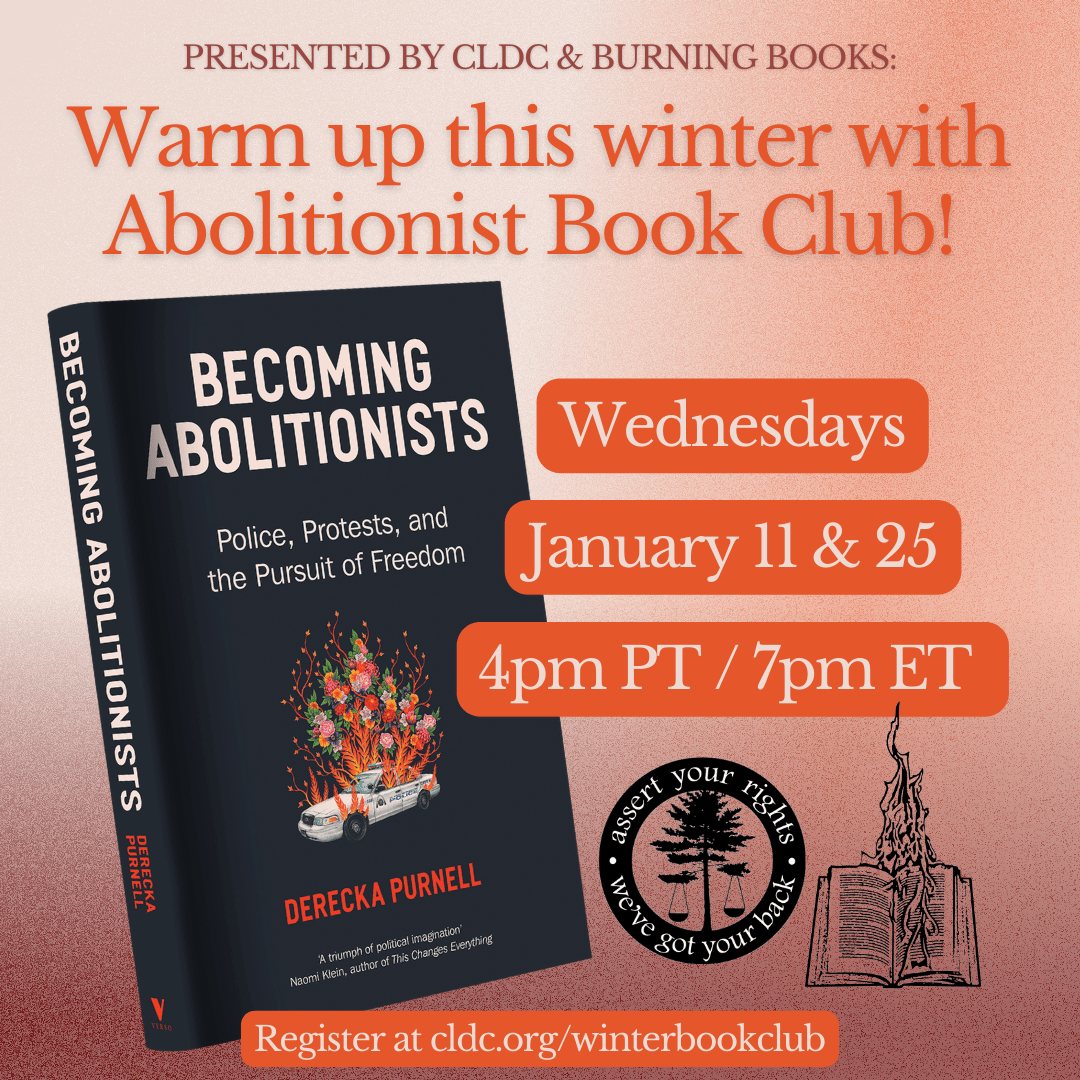
Réchauffez-vous cet hiver avec le Club de lecture abolitionniste ! Présenté par le CLDC et Brûler des livres.
Join CLDC and Burning Books on two chilly Wednesdays in January to warm ourselves up with Derecka Purnell's book Devenir Abolitionnistes. We will meet on January 11 & 25. 4pm PT/7pm ET.
The book club will include facilitated discussion by CLDC staff, Burning Books staff, and special guests.
This book is available for achat via Burning Books et est offert à un prix réduit aux adhérents du club de lecture. Lors de votre inscription, un code de réduction vous sera communiqué par e-mail.
Oups ! Nous n’avons pas retrouvé votre formulaire.

Description du livre : Now in paperback and with new material, a 2021 Kirkus Best Book of the year in both Nonfiction and Current Events, the book Naomi Klein called: “a triumph of political imagination and a tremendous gift to all movements struggling towards liberation.”
For more than a century, activists in the United States have tried to reform the police. Millions of people continue to protest police violence because these “solutions” do not match the problem: the police cannot be reformed.
In her critically acclaimed first book Becoming Abolitionists, Purnell draws from her experiences as a lawyer, writer, and organizer initially skeptical about police abolition. She saw too much sexual violence and buried too many friends to consider getting rid of police in her hometown of St. Louis, let alone the nation. But the police were a placebo. Calling them felt like something, and something feels like everything when the other option seems like nothing.
Purnell details how multi-racial social movements rooted in rebellion, risk-taking, and revolutionary love pushed her and a generation of activists toward abolition. The book travels across geography and time, and offers lessons that activists have learned from Ferguson to South Africa, from Reconstruction to contemporary protests against police shootings.
Here, Purnell invites readers to envision new systems that work to address the root causes of violence. Becoming Abolitionists shows that abolition is not solely about getting rid of police, but a commitment to create and support different answers to the problem of harm in society, and, most excitingly, an opportunity to reduce and eliminate harm in the first place.
 English
  Spanish
  Arabic
  Chinese
  Dutch
Dutch  French
  German
  Italian
  Portuguese
  Russian
  Hindi
Hindi