
🌎 Return our Roots and Reflection on CLDC’s Work
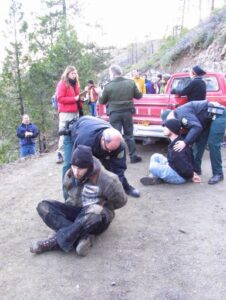
Caption: In 2005, Lauren is dealing with cops at the Biscuit timber sale protests in Josephine County, Oregon.
As another Earth Day approaches, the planet, the climate, and all of our communities are in crisis as a result of the gluttonous, short-sighted ignorance of the Trump authoritarian regime. No matter the issue of concern, this regime is making it worse—offshore oil drilling, clearcut logging, the gutting of any semblance of environmental protections — it’s pretty dire out there. The regime continues to attempt to distract and overwhelm people with a constant barrage of atrocities that has recently resulted in people focusing less on climate and environmental protections, and less visibility and impact for activists who continue to attempt to fight the multitude of attacks. As a strong proponent of knowing our history in order to employ more successful strategies in the future, I wanted to share a few thoughts.
In 1996 as I was finishing law school at the University of Oregon and getting ready to become an environmental lawyer in the Pacific Northwest, Congress passed the Emergency Salvage Timber Sale Program (“Salvage Rider”) as an addition to the Oklahoma bombing disaster relief bill. From 1996 to 1998, the so-called salvage rider expedited the devastating commercial logging of “dead, damaged, or down,” trees by exempting these sales from most environmental laws, court appeals, and public participation. Environmentalists called it “lawless logging,” and it irreparably threatened and destroyed endangered species habitat, old-growth forests, and water and fish habitat all across the Northwest.
As I began my legal career and focused on working with my friends and fellow forest defenders to use litigation to protect the places we loved, the failings of the legal system became all too clear. As corporate fat cats rushed in to profit from the lawless logging they had paid for in Congress, hundreds of activists put their bodies on the line to try to stop what the courts were prevented from doing by a stroke of the congressional pen. In one environmental case, I had filed a motion for a preliminary injunction to stop what would have normally been completely illegal logging on public lands. The court denied us the injunction. My clients called and asked if I would travel out to the national forest at issue to support their attempt to get the media to cover this act of pillage and irreparable harm. As I arrived, I saw my clients high in the trees that were threatened with logging, locked by their necks to logging equipment and forest service gates that blocked the access to the “sale unit.” As the day wore on, I watched my friends and clients physically harmed by law enforcement and loggers, and then dragged to vans and carted off to rural jails. As I stood by helplessly watching this unfold, the importance of direct action and the need to powerfully defend these bold individuals from the criminal injustice system, became clear to me. I found mentors and took on my first criminal cases. These were some of my earliest necessity defense cases—as both the environmental lawyer and the activist defense lawyer, my clients and I argued that we did everything we could within the law to protect these pristine public lands, but because Congress erased the environmental laws, the people had no option but to protect these forests with the only tools they had left—nonviolent direct action. As I stood in one Josephine County courtroom for a pretrial hearing, I stared at the model log truck the judge had on the judicial bench as we put on our expert witnesses, and smart, eloquent forest defenders explained why they were forced to break the law. We held back tears as we heard the judge paternalistically explain to us that logging helps salmon and that the old-growth forest was a crop that would grow back—and then summarily denied our necessity defense.
Decades later, we would finally win a few necessity defense cases on behalf of environmental and climate defenders, especially as more people began wrapping their heads around the reality that government is controlled by corporations but people still have the power to protect what they love.
And so, on this Earth Day remember that this is not the first time that the federal government has attempted to gut environmental protections and enrich their corporate cronies. In response, people will continue to stand up and do what is right even if the State attempts to criminalize those efforts. The worst thing we can do in the face of authoritarianism is to give up and stop resisting—if we censor our speech and weaken our activism, the State wins without doing a thing. Check out one of our “know your rights and risks” trainings—we are updating them all the time; download our free resources and share them widely; take yourself seriously and understand and mitigate digital security risks for the safety of everyone.
Over twenty years later, CLDC is bigger, more experienced, and even better at defending environmental and social activists in the courts and ensuring that the campaign and the litigation work together in solidarity with the struggle to protect what’s left. We are honored and grateful to be a trusted part of the fight for the liberation of all living things.
In solidarity,
Lauren