
How States May Utilize Domestic Terrorism Statutes
to Prosecute Activists
By: CLDC Law Clerk
On September 25, 2025, President Donald Trump issued a National Security Presidential Memorandum (NSPM-7) titled “Countering Domestic Terrorism and Organized Political Violence.”[1] In this memo, Trump claims antifascists “portray foundational American principles (e.g., support for law enforcement and border control) as ‘fascist’ to justify and encourage acts of violent revolution.” Trump continued: “This ‘anti-fascist’ lie has become the organizing rallying cry used by domestic terrorists to wage a violent assault against democratic institutions, constitutional rights, and fundamental American liberties.”
Trump then called on the Attorney General to “issue specific guidance that ensures domestic terrorism priorities include politically motivated terrorist acts such as organized doxing campaigns, swatting, rioting, looting, trespass, assault, destruction of property, threats of violence, and civil disorder.” This is a clear directive to tack on domestic terrorism charges in state criminal cases when an activist defendant is charged with simple trespass, minor property damage, or blocking law enforcement from entering a road.
Thirty-two states and Washington D.C. have passed domestic terrorism statutes. These statutes are written broadly and leave room to charge activists who act within their First Amendment rights. These laws typically include felony penalties. As a result, they can be used to investigate, prosecute, and intimidate domestic actors with whom the government disagrees, including protesters, activists, and non-profit organizations.
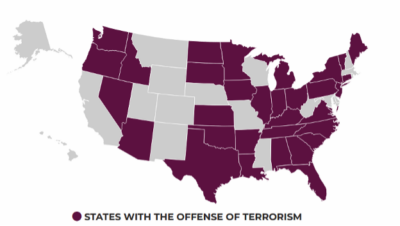
Domestic terrorism statutes typically include a specific intent element and a predicate offense. In Georgia for example, the specific intent element includes language such as: “intimidate the civilian population of this state or any of its political subdivisions” or “alter, change, or coerce the policy of the government of this state or any of its political subdivisions by intimidation or coercion.” This language is unconstitutionally vague, overbroad, and can be used against activists who protest within their First Amendment rights.
Moreover, these domestic terrorism statutes include specific predicate offenses designed to target activists. In Oklahoma, “Terrorism” can mean “an act of violence . . . resulting in damage to property.” Thus, minor property damage could qualify as a predicate offense. In Arkansas, an “act of terrorism” is defined as “any act that causes substantial damage to or destruction of . . . any monument used, owned, or maintained by . . . [the] State government.” Thus, an activist who decides to topple a monument of a notorious racist could be charged as a domestic terrorist. In Nevada, an “act of terrorism” can include a predicate offense of “coercion” which is intended to “cause substantial destruction, contamination or impairment of . . . any building or infrastructure . . . or any natural resource or the environment.” Thus, an activist blocking a road or access to a pipeline could be at risk of being charged with domestic terrorism.
Until 2017, Georgia’s domestic terrorism statute criminalized acts intended to or reasonably likely to kill or injure at least 10 people. After the massacre of nine Black parishioners by a white supremacist in Charleston, South Carolina, the Georgia legislature amended the statute to vastly expand its reach. The new law broadened the state’s definition of “domestic terrorism” to include certain property crimes committed with the intent to “alter, change, or coerce the policy of the government” by “intimidation or coercion.”
In March 2023, amidst the Cop City protests, the Department of Homeland Security issued a bulletin titled “Summary of Terrorism-Related Threat to the United States.” The bulletin warns of “lone offenders and small groups motivated by a range of ideological beliefs and personal grievances continue to pose a persistent and lethal threat to the Homeland.” It then claimed that “domestic violent extremists (DVEs) continue to attempt to motivate supporters to conduct attacks in the Homeland, including violent extremist messaging and online calls for violence.”
In September 2023, the Georgia Attorney General indicted 61 people involved in protesting the building of “Cop City.” All 61 defendants were charged under the RICO Act. Several defendants were also charged with domestic terrorism. In the indictment, the defendants were alleged to be members of Defend the Atlanta Forest, “an anarchist, anti-police, and anti-business extremist organization.” Moreover, they were allegedly “conducting, coordinating, and organizing acts of violence, intimidation, and property destruction in Fulton County, elsewhere in the State of Georgia, and other states.”
In the aftermath of the Cop City arrests, including “unprecedented arrests of organizers at a bail and legal defense fund” in Atlanta, movement lawyers challenged the constitutionality of the Georgia domestic terrorism statute. The lawyers filed a writ of habeas corpus challenging the constitutionality of the 2017 Georgia domestic terrorism statute. The petition argued that the domestic terrorism statute was unconstitutionally overbroad and “attempting by word or expressive action to alter, change, or coerce government policy is a quintessential act of free speech.” While the petition was unsuccessful, in September 2025, the Cop City defendants RICO charges were dismissed.
Domestic terrorism is defined in federal law as “acts dangerous to human life that are a violation of the criminal laws of the United States or of any State” and “appear to be intended to intimidate or coerce a civilian population, to influence the policy of a government by intimidation or coercion, or to affect the conduct of a government by mass destruction, assassination, or kidnapping.” While there is no federal crime of domestic terrorism, defendants may be charged under a wide range of federal criminal statutes. The Trump Regime will whole-heartedly support states using their domestic terrorism laws to charge political dissidents.
[1] https://www.whitehouse.gov/presidential-actions/2025/09/countering-domestic-terrorism-and-organized-political-violence/